
2025 Was Chaos: What Carriers Learned
If 2025 felt exhausting, that’s because it was.
For many carriers, it wasn’t just a bad year. It was a year of constant adjustment. Rates moved without warning. Costs stayed high. Planning felt pointless. And strategies that worked even a year earlier suddenly stopped making sense.
2025 wasn’t chaos because carriers didn’t try hard enough. It was chaos because the rules kept changing.
And while not everyone made it through, the year forced lessons that will matter far more than short-term wins as the industry moves into 2026.
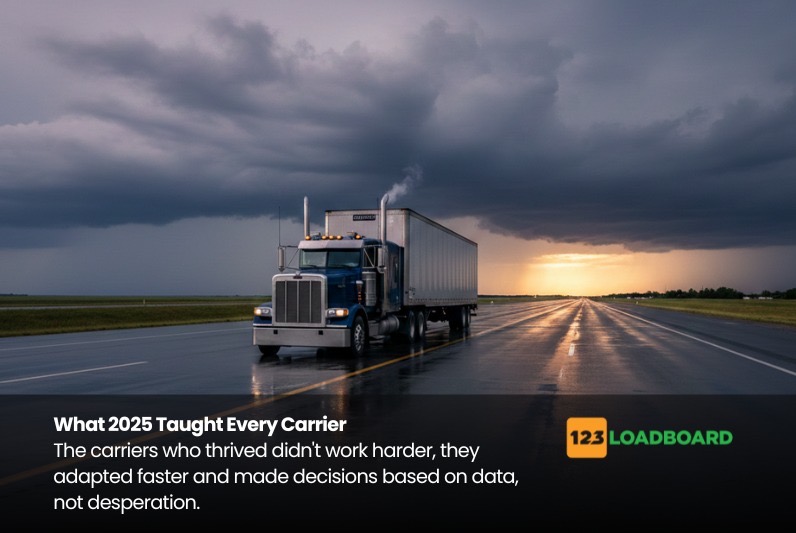

Why 2025 Felt So Unstable
Looking back, 2025 wasn’t defined by one single problem. It was defined by overlap.
Carriers were dealing with volatile spot rates, shorter renegotiated contracts, high fuel and insurance costs, uneven regional demand, and more competition for fewer strong lanes.
None of those issues were new on their own. What made 2025 difficult was that they hit at the same time and lingered. There was no clear “normal” to settle into.
Lesson #1: Volume Is Not a Safety Net
One of the biggest takeaways from 2025 was simple and painful: running more doesn’t protect you.
Many carriers tried to work their way out of pressure by taking more loads, accepting weaker backhauls, running longer weeks, and ignoring early warning signs.
In the short term, that kept trucks moving. In the long term, it magnified losses. 2025 exposed the limits of the “just keep hauling” mindset.
Lesson #2: Bad Lanes Compound Faster Than Bad Rates
A weak rate hurts. A weak lane drains you.
Carriers who struggled the most in 2025 often weren’t losing on every load. They were losing over time. Bad lanes meant longer deadhead miles, inconsistent reloads, being stuck in soft markets, and poor week-to-week planning.
Once you’re trapped in a bad lane, every decision after that becomes reactive. 2025 taught carriers that lane discipline matters more than single-load pricing.
Lesson #3: Flexibility Outperformed Forecasts
Plenty of carriers entered 2025 with plans. Few got to follow them.
The ones who adapted best weren’t the ones with the most detailed forecasts. They were the ones who could pivot quickly. They adjusted lanes without hesitation, let bad weeks pass instead of forcing volume, renegotiated or walked away when terms stopped making sense, and stayed liquid instead of overcommitted.
Flexibility wasn’t a bonus in 2025. It was survival.
Lesson #4: Knowing Your Numbers Is Non-Negotiable
2025 punished guesswork.
Carriers who didn’t clearly know their break-even rate, their cost per mile, their maintenance timing, or their true deadhead exposure found themselves making emotional decisions under pressure.
Those who knew their numbers could say no with confidence, adjust lanes before losses stacked up, and absorb volatility without panic.
The market didn’t get kinder, but clarity made it manageable.
Lesson #5: More Tools Didn’t Automatically Mean Better Outcomes
2025 also exposed a quiet issue: data overload.
Carriers had access to more information than ever, but not all of it helped. The ones who did better weren’t tracking everything. They were tracking the right things: lane performance over time, reload reliability by market, and rate stability, not daily spikes.
Technology helped, but only when it supported decisions instead of distracting them.
What 2026 Will Actually Reward
The lessons from 2025 point clearly toward what matters next.
2026 is unlikely to reward blind optimism, overexpansion, volume without margin discipline, or waiting for the market to fix itself.
Instead, it will reward carriers who apply what 2025 forced them to learn.
Discipline over hustle. Hard work still matters, but not without direction. Carriers who protect margins, choose lanes carefully, and avoid desperation booking will outperform those who simply run harder.
Consistency over peaks. Chasing occasional high-paying loads feels good, but consistency wins long-term. Repeatable lanes. Predictable reloads. Manageable schedules. Stability builds staying power.
Speed with intent. Fast decisions matter, but only when they’re informed. 2026 will favor carriers who spot changes early, adjust without panic, and use data as guidance, not gospel.
How 123Loadboard Supports Smarter Decisions
In 2025, many carriers realized that access alone isn’t enough. Finding loads is easy. Finding the right loads consistently is harder.
This is where 123Loadboard fits into the bigger picture, not as a volume solution, but as a visibility tool.
Compare lane behavior intelligently. Our Rate Check tool helps you understand which lanes make financial sense versus which ones are traps. In volatile markets, knowing when to say no is as important as knowing when to say yes.
Catch opportunities faster. Set up real-time load alerts for your preferred lanes. When the right freight appears, you’re notified instantly. Speed matters, but only when you’re chasing the right loads.
Plan with purpose, not panic. Use our Trip Builder to chain multiple loads together and see your real profit potential. Build routes like a business, not a gamble.
Stay mobile and responsive. Our mobile app lets you search loads by GPS and respond to opportunities on the go. Flexibility is your advantage when markets shift constantly.
Know your true costs. Our PC*Miler integration calculates accurate mileage, routing, and toll costs. Understanding your real cost per mile helps you avoid loads that look good on paper but lose money in practice.
Access fast funding when you need it. Through our partnership with eCapital, you can get quick funding for your loads to keep cash flow steady during uncertain times.
When used strategically, load boards help carriers compare lane options, understand market behavior, avoid reactive decisions, and move with more confidence.
The tool doesn’t make the decision. The carrier does.
The Quiet Wins of 2025
Not every win from 2025 shows up on a revenue chart.
Some of the most important wins were avoiding bad expansion, preserving cash flow, learning when to walk away, and building better habits under pressure.
Those lessons don’t disappear when markets improve. They compound.
Final Thought
2025 didn’t reward effort evenly. It rewarded adaptation.
The carriers who survived didn’t do everything right. They did fewer things wrong, faster.
As 2026 unfolds, the market won’t ask who worked the hardest. It will reward those who learned the right lessons and apply them consistently.
Ready to apply what 2025 taught you?
Sign up for 123Loadboard and get the tools that help you make decisions based on clarity, not chaos. The carriers who thrive in 2026 will be the ones who learned from 2025.
Give us your opinion!