
Navigating the Diesel Price Surge: Strategies for Small Fleets to Protect Margins
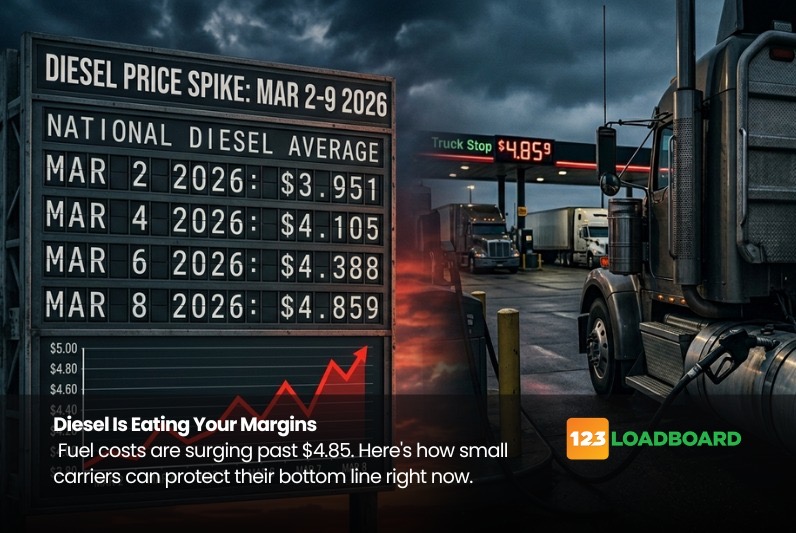
If you haven’t checked diesel prices this week, brace yourself, because the numbers are not pretty. As of the week ending March 9, 2026, the national average on-highway diesel price jumped to $4.859 per gallon, and in some regions prices pushed even closer to the $4.90 mark. (U.S. Energy Information Administration)
That’s nearly a dollar-per-gallon increase from the prior week in many areas, and analysts are warning it could get worse before it gets better.

What’s Behind the Surge
So what’s driving this? It all traces back to escalating geopolitical tensions in the Middle East, specifically the conflict involving the U.S. and Israel that intensified in late February 2026. Threats and active disruptions have effectively choked tanker traffic through the Strait of Hormuz, which normally handles about one-fifth of the world’s oil supply. (Reuters) .
That bottleneck pushed crude prices above $90 per barrel, and distillate markets, including diesel, went into overdrive. Diesel is actually climbing faster than gasoline right now because of tighter pre-existing supplies coming out of winter heating season combined with limited refining capacity. (FreightWaves)
Why Small Carriers Feel This Differently
For small carriers and owner-operators, this isn’t just a line-item increase on a spreadsheet. Fuel already accounts for somewhere between 20 and 30 percent of operating costs per mile for most trucking operations, and for independent operators or fleets running one to five trucks, an 85 to 96 cent-per-gallon weekly spike can flip a profitable run into a break-even situation or worse.
Large carriers have hedging programs and bulk fuel discounts to cushion the blow, but most small fleets don’t have those tools available. That leaves tough choices on the table. Operators may absorb the hit and risk cash flow getting squeezed, push for higher rates in a market where brokers may push back, cut miles, or idle equipment altogether.
We’re already hearing real stories from drivers in the field. Independent truckers are reporting fill-ups on 100-gallon tanks costing $600 or more, and smaller companies are projecting tens of thousands of dollars in added weekly fuel costs. (GasBuddy reports)
The timing also could not be worse because spot rates have been volatile, and any momentum toward a market recovery was just starting to build before this hit.
What You Can Do Right Now
So let’s talk about what you can actually do right now.
The most immediate move is to prioritize high-paying, efficient lanes. When fuel burns this expensive, revenue per mile matters more than ever, and running loads where the rate clearly outpaces your fuel cost is the whole game. Real-time rate visibility across multiple load postings lets you spot those opportunities quickly before they disappear, and right now speed matters. (FreightWaves)
Beyond lane selection, minimizing deadhead and idle time becomes critical. Every empty mile at $4.80-plus diesel is money you’re not making back, so matching backhauls and avoiding unnecessary repositioning runs needs to be part of every dispatch decision.
On the contracting side, if you have any agreements in place, now is the time to revisit fuel surcharge triggers with your brokers or shippers because many contracts include escalation clauses tied to EIA or OPIS indexes that could provide meaningful relief. (U.S. Energy Information Administration) Do not overlook the smaller efficiency gains either.
Optimizing your routes, maintaining efficient highway speeds, and using fuel-finder tools to hit cheaper stops along the way can add up to real savings across a week of runs.
Don’t Let Cash Flow Be the Thing That Stops You
The bigger picture here is that cash flow is going to get tight fast for a lot of small operators, but there are resources available. Working with a freight factoring partner means you’re not waiting 30, 60, or 90 days to get paid on a load you already delivered. Instead, you get access to that cash quickly so you can keep fueling trucks and taking loads instead of sitting still waiting on an invoice.
It will not solve the diesel price problem, but it removes cash flow from the list of things holding you back.
The Bottom Line
Stay close to the fuel trend data this week because analysts are warning of potential further increases ranging from 35 to 75 cents per gallon if disruptions in the Strait of Hormuz persist. That’s not a number to ignore.
The carriers who are going to come out of this stretch in decent shape are the ones acting decisively right now. They will choose loads smarter, cut waste where they can, and make sure cash is moving through their business. We’re here to help you find those loads.
When fuel costs are this high, every load has to count and that starts with finding the right ones fast. At 123Loadboard, we give carriers and owner-operators real-time access to thousands of fresh load postings so you can zero in on the high-paying lanes that actually make sense for your fuel budget right now. If you’re not already on the board, now is exactly the time to be.
Join 123Loadboard today and make sure every mile you’re running is a mile worth running.
Give us your opinion!