
Could Better Freight Be Around the Corner? Here’s One Signal We’re Watching
If the last few years taught carriers anything, it’s that this market can turn on you fast. Good week, bad month, decent quarter, then back to sitting at a truck stop refreshing your load searches and wondering where everything went.
So when a signal shows up that’s worth paying attention to, we think it’s worth talking about. And the one we’ve been watching lately has nothing to do with rates or diesel prices.
It’s coming from retail inventory.
The U.S. retail inventories to sales ratio has been sliding for months. It sat at 1.28 back in December, and by April it had worked its way down to 1.26, the lowest reading in more than three years (U.S. Census Bureau, Journal of Commerce).
That sounds like something an economist cares about and you don’t. But stick with us, because it actually connects back to your truck.
Here’s the short version. When retailers have less product sitting on shelves and in warehouses, they eventually have to restock. And restocking means somebody has to haul it.
That’s not a promise that loads are about to flood the board next Tuesday. It’s one signal among several, and we’d rather explain it honestly that hype it up. But it’s a real one, and it’s pointing in a direction carriers have been waiting for a while.
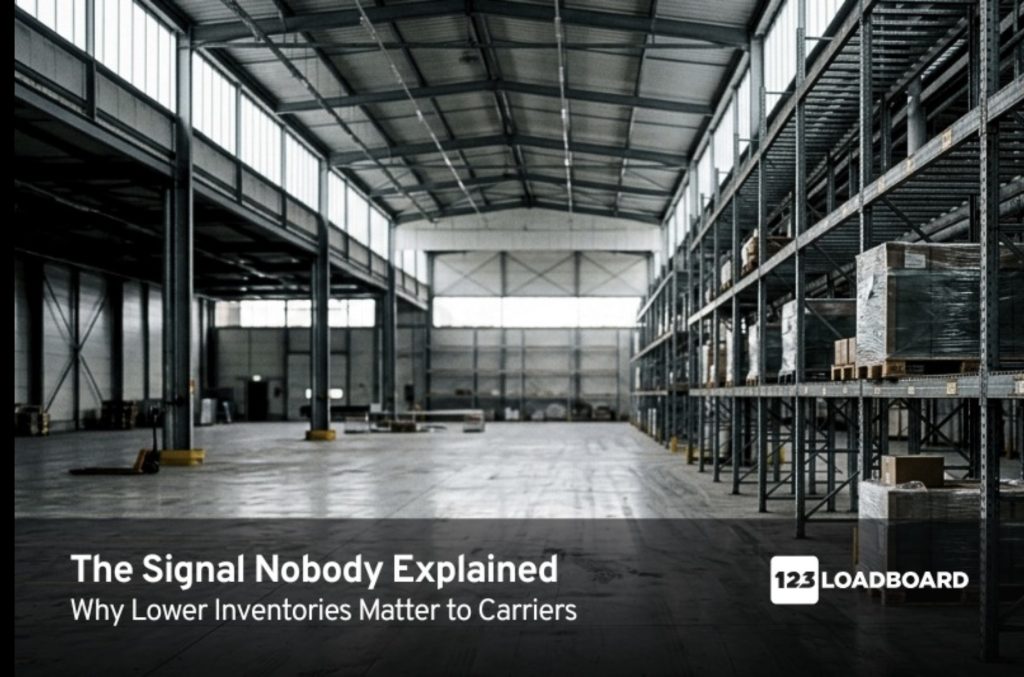
Less product on the shelf means restocking, and restocking means freight has to move.

What the Inventory to Sales Ratio Actually Measures
Strip away the jargon it’s a pretty simple idea.
The ratio compares how much product businesses are holding versus how fast that product is selling. High ratio means the warehouses are full and sales are low. Low ratio means product is moving out the door faster than it’s coming in.
When inventories are high, companies sit on what they’ve got. They’re not calling manufacturers, they’re not booking extra trucks, and freight demand stays soft. That’s basically the story of the freight market for a good stretch of the last few years. Everybody overbought coming out of 2021 and then spent a long time working thr
When inventories are high, companies sit on what they’ve got. They’re not calling manufacturers, they’re not booking extra trucks, and freight demand stays soft. That’s basically the story of the freight market for a good stretch of the last few years. Everybody overbought coming out of 2021, then they spend a long time working through it.
When inventories get lean, the opposite happens. Shelves need refilling. Orders go to manufacturers. Product moves from plants to distribution centers, and from distribution centers to go stores. Every one of those moves is a load, and most of them go on a truck.
That’s the connection. Retail inventory doesn’t feel like a trucking number until you follow it far enough down the chain.
What the Big Carriers Are Saying
The inventory number didn’t come out of nowhere. It came up because executives at some of the largest freight companies in the country were asked how business is going, and a pattern showed up in their answers.
Old Dominion, Saia, XPO, and C.H. Robinson all described something similar on their calls:
- Contract pricing is strengthening
- Capacity is getting tighter
- Freight demand is gradually improving
- Retail inventories are getting leaner
Now, none of those on its own means much. Contract pricing firming up doesn’t automatically help a guy running spot freight out of Laredo. Tighter capacity is great until you realize it partly means carriers went out of business.
But put all four together and you get a picture of a market that’s in better shape than it was. Not booming. Better. And after the stretch we’ve all been through, better is worth noticing.
What This Could Mean for Owner Operators
If retailers start placing bigger restocking orders over the next few months, here’s realistically what that looks like from the driver’s seat:
- More loads posted, especially in retails heavy lanes
- Shippers competing a little harder for available trucks
- Certain lanes tightening up before other do
- Spot rates continuing to firm up instead of sliding
The word we keep coming back to is opportunity, not guarantee. Freight markets almost never improve everywhere at once. It starts in a few lanes, in a few regions, with a few commodities, and its spreads from there.
Which means the carriers who noticed it first are usually the ones already paying attention.
How to Be Ready Without Betting the Farm
Nobody can tell you exactly when volumes will pick up or which lane is going to pop first. Anybody who says they can is selling something.
But there’s a difference between predicting the market and being positioned for it. A few things that help:
Stay flexible on lanes. If you’re only running one corridor, you only benefit when that corridor improves. Carries willing to run something different are usually the first to find the better paying freight when demands shifts around.
Watch the board more than you think you need to. Conditions move faster than the headlines do. Checking loads regularly, even on days you’re already booked, gives you a feel for what’s tightening and isn’t. That instinct is worth real money later.
Keep killing deadhead. Operating costs aren’t dropping just because demand improves. Every empty mile still comes straight out of your pocket. Planning the reload before you deliver is one of the few things fully in your control.
Move fast when something good posts. Good loads don’t sit. Real time searching and load alerts matter most in a market that’s turning, because the gap between “that’s a great rate” and “that load is gone” is measured in minutes.
The Bottom Line
One indicator never tells the whole story. Retail inventory could stay lean for months without much showing up on your end, or consumer spending could soften and reset the whole picture.
But falling inventories, firmer contract pricing, and tightening capacity all pushing the same direction at the same time is a pattern, not noise. It says the market is grinding its way back toward something healthier.
For carriers, that doesn’t mean it’s time to coast. It means it’s time to be ready, because the operators who benefit most from a turning market are the ones who were already watching for it.
Stay informed, stay flexible, and keep your options open. This industry has a way of rewarding the people who saw it coming.
At 123Loadboard, we build tools to help you move quickly when the market does. Real time load searches, custom load alerts, route planning, rate insights, and a nationwide network of freight all in one place, so you’re not the last one to know when a lane starts paying better. Start your free trial and see what’s moving in your lanes today.
Give us your opinion!